Saturday, 26 October 2019

Machine Learning: Lecture Notes (week 4/5)/Neural Networks

My earlier blog posts on Neural Networks are here.

Neural Networks are suitable for more non-linear representations. When the feature set gets bigger, the polynomial will be unreasonably big.

Terminology:

The course considers two types of classification: Binary and Multi-class classification.

The cost function will be a generalisation of the cost function for logistic regression. For the multi-class case, the cost function will be calculated for each output.

Back Propagation - Cost Function
Back propagation starts with calculating the error of the last hidden layer (L-1). Using that, the second last hidden layer (L-2) can be estimated etc, back to the first layer.

The cost function for neural networks is more complex than the cost function for regularized logistic regressions, with a couple of nested summations.
Let's look at the summations:
  • The first summation spans over the training set. This is similar to the logistic regression.
  • The second summation spans over the output nodes. This means that the cost function must consider all different output bins.
  • The first summation in the regularization term spans over all layers:
    • The second summation in the regularization term spans over all the input nodes in the current layer, including bias unit (number of columns in the matrix)
    • The third summation in the regularization terms spans over all the output nodes in the current layer, excluding the bias unit (number of rows in the matrix)

Saturday, 5 October 2019

Machine Learning: Lecture Notes (week 3)

These are some lecture notes from the third week of the online Machine Learning Course at Stanford University.

Classification
Many machine learning problems are concerning Classification. That may be "dirty/clean", malignant/benign tumor, spam/no spam email etc.

In this case, the training output y will be either zero (negative class) or one (positive class) for the two class case.
Logistic Regression / Hypothesis Representation
Logistic regression model is improved with a sigmoid function:
The sigmoid function offers a smooth transition from 0 (z << 0) to 1 (z >> 0).

hθ(x) is the probability for a positive result, given the input x.
Decision Boundary
A decision boundary is the limit between the set of x that results in hθ(x)>0.5 and the set of hθ(x)<0.5

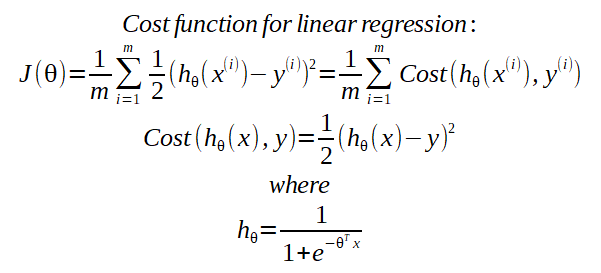
Cost Function

This cost function will give zero cost, if the hypothesis is correct and an infinite cost, if the hypothesis is incorrect.


Simplified Cost Function and Gradient Descent
For the two binary cases for the cost function (y=0 and y=1), the cost function can be written as:


This function be derived using maximum likelihood estimation.

The optimization problem is now to minimize J with respect to the parameters and the observations.
The gradient descent method will update the parameters with the error multiplied by the observations:
Advanced Optimization
Another optimization algorithms are
  1. Gradient Descent
  2. Conjugate Gradient
  3. BFGS
  4. L-BFGS
2-4 doesn't need to select alpha (learning rate) and are often faster than gradient descent. They are also more complex.

Regularization
Too many features in the hypothesis may cause overfitting. That means that the model fits the training set perfectly but misses out in new cases. There are two ways to handle overfitting:

  • Reducing number of features (manually or using a selection algorithm)
  • Regularization (keep all features but reduce magnitude of theta)

Regularization will add the sizes of some hypothesis parameters to the cost function. The first theta parameter will not be optimized by convention.

The vector form will be:

Saturday, 28 September 2019

Machine Learning: Lecture Notes (1)

Here are some lecture notes from the second week of the online Stanford course in Machine Learning. I take the notes for myself as a form of rubberducking.

Terminology from week 1 (single feature linear regression):

  • m is the number of training examples. 
  • n is the number of features.   
  • y is the output from the training set 
  • x are the input features in the training set
  • x(i) are the input features of the ith training set. 
  • hθ =>θ01x1 + ... + θnxn is the hypothesis function that will be modified to fit the training set.
  • θare the hypothesis values for each feature.
  • J is the cost function. A common cost function is the mean square error function
  • α is the learning rate


Multiple features:
It is common to add a constant feature to the model: θ0, where x0 = 1
Using matrices, hθ (x) = θTx
Gradient Descent Algorithm
For each θj
    Add the derivative of the cost function for that feature
    Add α times the average of the (hypothesis minus the actual observation) multiplied by that feature value.
Gradient Descent - Feature Scaling
The gradient descent algorithm can converge quicker if the feature range are scaled to the same interval.
Feature scaling is dividing the input variables by the range of the input variables. The new range will be 1, but the values can still be higher.

Mean normalization means subtracting the mean from each value. If you combine those methods, you get:
xi := (xi - mean(x))/range(x)

Normal Equation
This is a way to minimize J without iterations.
Gradient Descent or Normal Equation
GD: Need to chose a learning rate. NE: No need to choose a learning rate.
GD: Needs many iterations. NE: Needs no iterations
GD: O(kn^2). NE: O(n^3). NE is heavy for large feature sets!


The next step is a programming assignment where I'll implement linear regression to a simple data set. I won't publish that on my blog, however.

Saturday, 21 September 2019

Machine Learning: Online Stanford Course

I have spent some time on programming this week - but not on my pet projects.

For obvious reasons, I can't elaborate on the programming I've done at work more that I have learnt a lot.

I've joined a dojo excercise on Machine Learning with an online course from Stanford/Coursera. We followed an example where we implemented a simple linear regression.

So far, I think the course is good for a beginner in AI. I seriously consider purchasing a course certificate when I finish that course.


Saturday, 14 September 2019

StockReader: White and Black Lists

As I mentioned in earlier blog posts, I want to have a black list and a white list for combinations of expected name and returned names. Now, I got that code working.

An XML file lists all valid combinations (white list) and invalid combinations (black list). When the program is started, that XML file is opened and the lists are read into two dictionaries.

When the program finds a new stock record, it will query the class nameChecker for the combination of the expected name and the returned name. The result will be one of the following:

  • Found in white list: The record can be added to the database
  • Found in black list: The record is faulty and will be discarded.
  • Found in neither white or black list: The combination needs to be assessed by the user manually. The record won't be added to the database. Instead, a proposal xml string is printed to the console when the scanning of records is done.

One of the few methods that is properly commented.
I really need to refactor my code.
The output can be copied into the XML file for the next iteration:

This means that there will be a lot of manual work initially. Once the lists are updated, unknown mismatches will be less frequent.

The current version of the web scraper builds the list of stocks dynamically and mismatches should be very unlikely.

Side Note: I'm focusing more on programming tasks at work. Therefore, I'll have a slower pace on my spare time projects and sometimes, I'll update the blog every second week, instead of every week.

Saturday, 31 August 2019

StockAnalyzer: Adding XML Reader to the Program

I've created a separate page for StockReader and StockAnalyzer, with a short summary of the programs. In this blog post, I'll use XML and C# dictionaries to verify that the stock names are correct for the stock records.

When feeding the stock records from the csv files, I need to verify whether the stock name I queried (the first string) matches the actual stock record that I got (the second string).

As I mentioned in my last post, I'll have three lists of valid, invalid and unknown combinations in a XML file. The program will read that file and populate corresponding dictionaries.

When the program reads a stock record, it will look for the stock names in the dictionaries.
  • If it is found in the white list, that stock record can be added to the database.
  • If it is found in the black list, that stock record is ignored.
  • Otherwise, the program will print a recommended xml tag. The user can decide on whether to add that tag to the white or black list.
The user will edit the XML file and move combinations from the gray list to the black or white list manually.

XMLReader vs XMLDocument in C#
XMLReader is a read-only representation of the XMLDocument. The reader requires more code but is less memory consuming. I've decided to use the XML


New Class: NameChecker
The name checking will be handled in a separate class, that is called from fileParser. I'll implement it in the next post.

Mapping the Wanted Stock Name to the fetched Stock Name
In C#, there is no mapping from value to key in dictionaries. Key to value mappings are smooth. Therefore, searching for the key will be time consuming.

I'll use the dictionaries to search for the key (the fetched values). This will give a list of values that represent the wanted values (most of the cases one value).

Saturday, 17 August 2019

StockAnalyzer: Handling Stock Name Mismathes

One early flaw of the earlier versions of my webscraper was that it used hard coded links when retrieving the stock data. The links were based on hard coded numbers and I needed a safeguard check to detect if those numbers changed.

The program took the first Name ("Eniro") as the stock name. It used the corresponding numbers (869, 2398 and 46100341) to build three URL strings to fetch the stock data.

For that reason, I had the stock name as the two first entries: The first name is the stock that I want to fetch and the second name is the stock that was actually collected. Ideally, the names matched each other, but there are several mismatches.

I need to verify the stock records before adding them to the database. One check will be to see whether the first string is "---Void---" or not. That string was a placeholder and that record shall be discarded.


Further, I need to check whether the stock data I have really matches the stock name or not. To do this, I'll use a XML file that contains three lists:
  • White List for the allowed combinations of names,
  • Grey List for the combinations of names that hasn't been verified by the user yet and
  • Black List for the illegal combinations of names (these records will be ignored by the program).


A lesson learnt from this is to make sure that the web scraped data is in a good shape already when scraping. The next blog post will cover some XML topics for CSharp.