Showing posts with label SKLearn. Show all posts

Saturday, 24 October 2020

StockPredictor: Using Neural Networks to Try to Predict Stock Values

With the verified training data, I've been trying to predict stock performances, given some key numbers. 

I'm using the scikit toolbox for Python and the initial findings is that the neural network hasn't been able to predict the stock performances. The correlation between the predicted values and the target values is close to zero. 

Findings
I've run several iterations with different parameters, like alpha (learning rate), random state, batch size and whether to use historic data or not. They all point to the same conclusion - there is no easy-to-catch pattern that the neural network can find. 

These finding support the efficient market theory - the past information is already priced into the current stock prices. 

The distribution of the result data is hard to model using a neural network. Most of the data is small, but there are some few outliers that generates large losses for the training function.

The result distribution. 95% of the results are in the range -0.0143 up to 0.0166,
but some outliers are much bigger.


For reference, I trained a neural network for a dataset that is available in sklearn (load_diabetes). That network found a quite strong correlation between predictions and the results (75%). This means that I know how to set up and use data sets for machine learning. 

Summary of the project and the future
I have no plans to continue the project at this moment. The web scraper will keep recording stock records and I'll update the documentation.

Lessons learned:
  • Verify the data early in the project!
  • Use standard schemes for saving the data. Preferably CSV format, and/or a format that can easibly be imported into a database.
  • Add checks for inconsistent data that notifies the operator.
Unplanned future work:
  • Map the results into an machine-learning friendlier distribution. Maybe logarithmic scale?
  • Iterate over different prediction windows. Currently only 7 days is used.
  • Use other algorithms, like K-nearest neighbor.
For the end of the year, I'll explore Internet of Things (IOT) with Arduino and Raspberry PI. The train project will continue in 2021.

Saturday, 26 September 2020

StockPredictor: Adding Past Values to Training Data

In my training data for the predictions, I use the following data to predict the changes in stock prices:

Stock Price, P/E, P/C, Yield, Price Margin, RSI and the number of days to dividend. 

I want to be able to add historic key numbers as well and I'll specify that using bit masks,

PriceP/EP/CYieldRSIPMRSI
Days to Dividend
Todayxxxxxxxx
One week agoxxx
Two weeks agoxxx
Three weeks agoxxxx
Code (binary)
11110101100111011011000100010011
Code (Hex)F59DB113

For simplicity, if one parameter is required two weeks ago, the script that generates the training data will add all parameters two weeks ago. The selection of parameters will happen in the prediction script. 

There won't be matching historic dates for all stock records in the database. For the historic dates, I'll try the calculated date +/- one day.
If the current stock record date is on the 27th, I'll search for the one-week-old record on the 20th. If that date can't be found, I'll search for the 19th and 21th. If neither can be found, the program will give up fetching records for that date.

This means that the training set will be some 50% smaller. Removing half of the training set in order to train the neural network on what happened to stocks over the last weeks can, in theory, bias the underlying data. Assumption: I assume that the performance of the recorded stocks are independent on when I recorded the training data.

In the network trainer, the data that isn't used will be removed from the training set. The script will drop the columns that I don't need according to the bitmask.

The next step is to evaluate some machine learning algorithms on the data.

Saturday, 12 September 2020

StockPredictor: Selecting Algorithm and Some Design Considerations

This is the third part of the stock project, where I will use the validated data to train a machine learning system to predict the performance of a stock based on the data that was available at the date of the stock record.

The first step is to make some design considerations for the algorithm. The earliest program will only look at the current stock record for features (X) and the results (y) will be the daily change of the stock.

If I select the prediction window to one week, one example of features and results would be:


The results from a query in the database will look like this:

The X data can consist of values of P, P/E, P/C, Yield, PMI, RSI and the time to/since the last dividend. The y data for the stock record of 2018-10-31 will be the change (%) divided by the days: 
The daily increase of ABB's stock price was 0,054% during one week in November, 2018.
It would have been more mathematically correct to take the seventh
root of the quota, but this time I'll prefer simplicity.

For training data to be useful, there must be a price record in the future that can be used ad y.

I'm saving the data to a huge panda dataframe (the process of populating it from the database (with some necessary processing) takes ~35 minutes. To avoid repeating this cumbersome process every time, I save the dataframe to a csv file, that can be used directly to train the machine learning algorithm. Loading that file takes less than a second.

The Data Set
I suspect that some of the data are highly correlated to each other. For example, Price, P/E and P/C are correlated in the short-term, since earnings and capital per share seldom changes. 

Sometimes, the data contains zeros or null values. 

Regression or Neural Networks

Both regression and neural networks has some pros for this dataset. 

Linear regression

A linear regression would be intuitive for predicting the change in stock price. But there are some zeros in the underlying data that I fear will skew the results. It also seems to be tricky to handle XOR relationships between features. 

Multi-Layer Neural Networks can model complex relationships such as XOR relations and zeroed records. I'll start with this one initially. The

SciKit-Learn

Sklearn has a neural-network-ish regressor that I will investigate.


Saturday, 11 January 2020

2019 in Retrospect


This year, I've had some progress on my pet projects. The progress rate was slower in Q4 as we have bought a house. We'll move there in 2020.

Maintaining a house will require some work and learning activities. I expect that the pace of my pet projects will be slower than before.

2019
  • TrafficControl (C++ / Qt) - Paused
    • No work on this project in 2019.
  • StockReader/StockAnalyzer (C# / SQL / MSVC) - Current focus
    • Creating a C# program that scans a folder for result files, extract stock records and parses the data to a database. I've got some experience with Microsoft Visual Studio by now and I'm still learning...
    • Next step will be to fix issues with data conversion to SQL
    • After that, I'll explore some Machine Learning algorithms and check if I can predict stock price changes based on key numbers.
  • ApartmentPredictor (Python) - Done
    • A Python script that made Linear Regression Analysis of past apartment prices in an area. The predictions were based on the apartment size and the monthly cost. 
  • Machine Learning Course at Stanford (Octave / Matlab)  - Done
    • I successfully attended and finished the course in Machine Learning from Stanford University.
    • I applied some machine learning for a pet project for a friend. The simulations indicated that the result was random to a very high degree,
  • TravelTimeCalculator (Java / SQLite / Android Studio) - Done
    • I've completed the project now. TravelTimeCalculator allows the user to compare travel time/cost between several positions on a map. They can also customize the travel cost to consider both travel time, economic costs and environmental cost.


  • Work (C / Python / 4G / 5G) At work, I've focused on test and some coding for 5G with focus on antenna calibration.
To Do in 2020:
Prio 1: The New House!
Prio 2: StockReader/StockAnalyzer

Saturday, 20 April 2019

Machine Learning: Using a Neural Network for Value Prediction

Until now, I've been using a Neural Network for a binary classification. Predicting a continuous value would be more relevant for my case.

I found an example that is using the sckit-learn package.

The Peer Project
This time, I've made some changes to the input data:

  • I will make the neural network train for the actual training output data instead of a binary representation of that data.
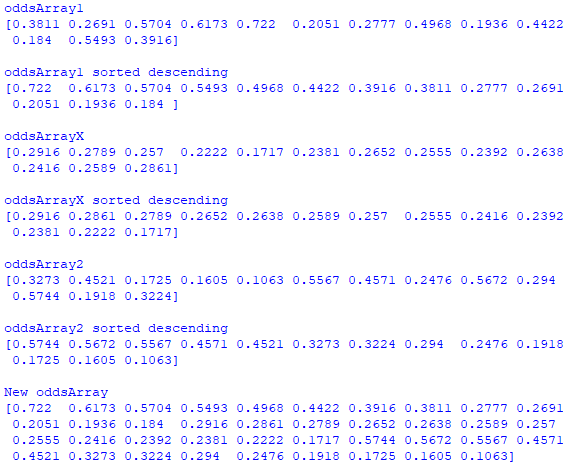
  • I will sort the training input data in three groups of thirteen values:
The values are initially arranged in triplets (likelihoods for events 1, X and 2) for thirteen samples. 
I sorted the array by descending values with a simple modification of the numpy sort command:

I use the MLPRegressor with some different random seeds and 10000 iterations.

The results are a bit disappointing. For some random seeds (and different sets of training/test data), the errors are smaller after 10000 iterations, compared to after one iteration.
Seed 300, 10000 iterations. 

Seed 400, 1 iteration

Seed 400, 10000 iterations

Seed 400, 1 iteration

The error messages are reoccurring and indicates that the convergence is too weak. It seems not to be any easy-detectable link between inputs and the magnitude of the output.  

Adding more iterations seems not to be the magical solution either.
For 20 000 iterations, the error is smaller than for 10 000 iterations.
But for 40 000 iterations, the error is increasing.
It seems that it is very important to be able to interpret the neural networks!

Checking a Known Data Set
As a sanity check, I've been training the MLPRegressor on a small training set:
This sample should be quite easy for an neural network to train.
I tested with a test size of 0.2 (6 or 7 samples in training set and 1 or 2 samples in test set):

One iteration:
The MLPRegressor wasn't able to converge after one sample.
This makes sense, since it takes quite a number of iterations to converge.
Ten iterations:
I still see the warning about convergence, but the errors are smaller.
This means that the algorithm is converging after all
A Thousand Iterations:
The error isn't shown anymore, and the errors are smaller now.
A Million Iterations:
Here, I'm running twice on the same setup.
The first optimization converged much more poorly than the second one.
The reason for this is probably an unfortunate selection of training data.  
Another optimization with a poor distribution of test and training data.
The training data contained all the "zeros", but the test data contained none.
This made a difference between the training and test data. 
The example above illustrates how important it is to have a big set of data to test and train on. 


I'll finish this part of my Neural Network project for now. The next project will start in the next blog post and cover much more training data.